 |
You only buy inventory for one reason: as an investment that will pay you a profit later. "Later" is defined as within the next 365 days.
We know that "expenses" vary with activity, but let’s assume our expenses stay the same. The total was $111.00. So if we buy the item for $100 and expenses are $111 (total=$211.00) what can we sell this for and make a profit? If you buy it in January (same as before) but sell it by Mother's day (May) for $165 rather than $225 you'd make only $65 in profit. BUT............... Restock it in June at $100 and then sell it buy Christmas for $165 again, here's the number for the year: 2 Sales @ $165 = $330.00 Buy it twice: 2 x $100 = cost for the 2 items sold: $200.00 Gross Profit: $130.00 Selling it one a year made us $111.00. Selling it twice at a lower retail price made us $130, $19 more. Here's the problem. Jewelers are happy to sell it for less to make a sale but jewelers are lazy about selling another one in that year to make up for lowering the selling price. This is simple in its idea but many, many jewelers get lost after what to do after year 1. Let's be candid here, you do have over 1000 pieces of inventory to look after so how are you to manage this? That's why you need a good point of sale program. I'm going to simplify this for year and now you can hold any item accountable. Here's the example from above. It cost $100 and needs to sell for $225.00. That's $125 in profit we are required to bring in on our $100 investment. Divide the $125 in profit by 12 months and another way of looking at this is that item needs to give us $10.42 a month in gross profit. So for each month it does not sell the item owes you $10.42. think of it like loaning a friend $100 and each month he owes you $10.42 in interest. High rate? yes but this interest also has to pay for salaries, rent, advertising, etc so it must be that much. (Called Gross Profit). So if you buy it in January and it sells in April, the item owes you $10.42 x 4 months = $41.68 in gross profit. Add back in the cost ($100) then it sells for $141.68 in April. Do that 2 more times this year and total profit taken in will be $125.04 in gross profit. Add back in the cost of $100 and that's how we get the selling price of $225. So many of you look at a $100 needs to bring in $125 in gross profit and added together is the selling price of $225. But try looking at it monthly and you'll get antsy after a year. We expect $125 in profit in a year which is $10.42 per month. Watch: 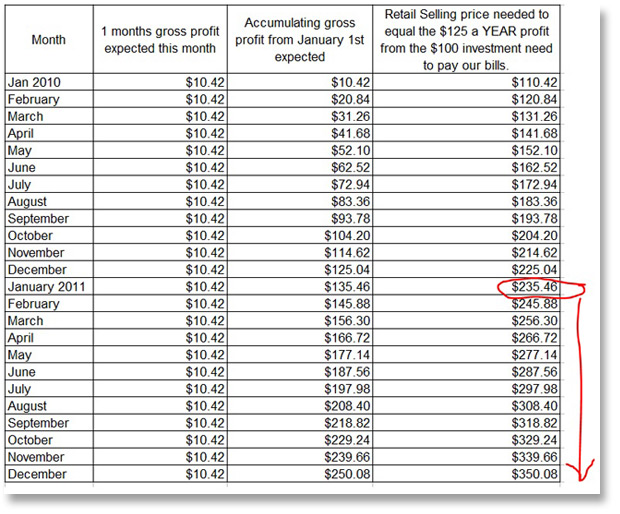 The right hand column is TURN in its purest form. You can sell it for LESS as long as you sell it more OFTEN in the first year. By the end of the year you have the same total gross profit required ($125). But start in the 2nd year you are already in the mindset of selling it LESS OFTEN. Nothing you can do about that, it is what it is. So now to sell it LESS often you now have to revert for selling it for MORE. Please notice if you sold this item in June 2010 it can sell for $162.52. That's $62.50 in profit. If you sell it in December it sells for $225.04, $125.04 in gross profit. The first sale took 6 months and the second one takes 12 months. Add that together and you get 18 months total time frame and if you add the 6 month profit to the 12 month profit ($62.50 + $125.04) profit of $187.04. So look above if you held the item for 18 months, selling it June 2011, The accumulated gross profit is $187.56. Its the same gross profit needs to come to you whether you sell it in 6 months and resell a new one a year later as if you hold it for 18 months. Nothing's changed. That item needs to bring in $10.42 each month it sits in the case. If it stays there for 3 years then it has to sell for: 36 months x $10.42 = $375.12 + $100 original cost = $475.12 It was tagged at $225 but now must sell for $475.12. if it does you'll make exactly the same amount as it should have just buying and selling it once a year, three times over 3 years. But the real questions that need to be answered are:
So you need to dump it and move on. Its a no win situation, take the hit and try another profit that will do better. If this items stays for another 3 year you'll lose another $475.12 in lost profits. So in 6 years you'd lose $750 in profits because it didn't sell. if you sell it at or near cost (or more if you're lucky) then you stop your losses and begin making profits again. So in year 3 lets assume you get your cost out of it (give up on making a profit Charlie) and you buy a different item for $100.00. But the difference is now it SELLS EVERY YEAR! So now it'll make $475 for the next year years rather than losing $475. Original item, sitting in stock for 3 years: What it didn't make: $475.12 If it stayed in stock 6 YEARS: What it wouldn't make $950.24! 6 year old item: Should have made in profit $950.24 What it actually did make in profit over 3 years: $00.00 ZERO If we dump the item after 3 years and buy a good seller: 1. We dump it, getting our cost out only, amount of gross profit made in 1st 3 years: $00.00 2. Profit made the next 3 years (years 4, 5 & 6). $475.12 Item dumped after 3 years and replaced and managed well for the next 3 years (same 6 year period) Should have made in profit $950.24 What it actually did make in profit over 3 years: $475.12 So as you can see you can't make up for what did happen in the past but you can make up for lost time & profits in the future. One question comes up is this: "Could I be lucky enough not to have to dump an old item and have a customer come in on year 4 and buy that item and not have to discount it or sell it at cost?" David's answer: "You pretty much stink at it for the past 3 years, what makes you think you'll be an awesome retailer with a 3 year old dud now?" Just take the hit and move on. This happens to be what other retail industries do. Clothing industries dump merchandise at the end of a season. How long is a season? 4 months!!!!!!! Not 4 years!!!! Having a profitable year has a lot more to do with how well you handle inventory (which is a balance sheet item) rather than making a profit when you do sell it (which is a profit and loss statement item). Making a profit is one thing, having money and low debt is another. Sincerely
|