

"Would You Like a Shampoo With That Diamond?"
I live at 10,000' in the mountains of Colorado, and when a person needs to get a haircut, the options are limited. We don't have barbers per se but we do have "salons," which in this area cater to the well-heeled tourist. I'm not their target demographic, yet they never seem to realize it.
"I'd like a haircut."
"OK, and this week we're doing a special on manicures, in case you're interested."
"Just a haircut."
"Certainly, come right over here for a shampoo, please…"
"No, I don't want a shampoo. Just a haircut."
"No problem, and what shall we be doing with your hair today?"
"Cutting it."
"Yes, of course, but what did you have in mind? For example, do you want it over the ear, or straight at the ear?"
"Haven't a clue. Whatever you did last month."
"And how much would you like cut off?"
"A month's worth."
"Any gel, today?"
(This generally earns them a stare, designed to stop further conversation.)
Salons are all about women, and the goal is to provide "an experience." Often this includes a shampoo, a nail treatment, a whatever, a whatever, and a whatever. I don't even know what services they have, nor do I want to know. A man is as out of place as a fish in a…Denver Bronco's locker room. I enjoy the "salon experience" about as much as a trip to the dentist. At least at the dentist they give you nitrous.
The salon staff—in my case—simply mis-analyzes the customer. After I declare my desire for a haircut, the answer I want is: "Certainly, we can take care of that in eight minutes, maybe less. Let's cut the gab and get started."
It isn't a question of what type of customer is more desirable. Or what type of customer the store should specialize in. In today's economy, with competition being so ferocious, it's adapting to whatever customer walks in the door. It's a minor miracle for that customer to walk in the store in the first place. If a woman wants a four-hour languorous experience, give it to her. If the rude guy wants to make it quick and snappy, give him quick and snappy. Heck, if the customer walks into the wrong door and is actually looking for pizza—take the order and then call Dominoes. Add a 20% service fee.
Or maybe not. There's still the issue of core competency. Probably the hair salon or the jewelry store should not be flipping pizza orders. You have to decide what business you're in, and stick to your core competency. But your core competency may be broader than you realize. MBA-types call this "brand-extension," yet it's tricky to know how far to extend. A successful hair salon that adds, let's say, nail treatments isn't living too dangerously. But what about full body massages? Full body massages and by the way we'll wash and wax your car. And walk your dog. And tutor your kid in math. At some point you've extended your brand too far.
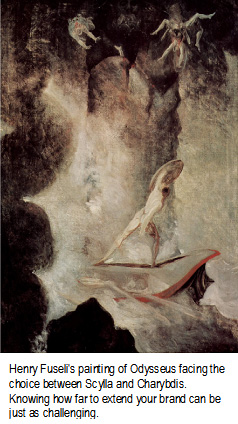
Being brave enough to extend your business beyond its traditional comfort zone, yet wise enough not to go too far, can be like Odysseus navigating between Scylla and Charybdis. We've struggled with this issue at Polygon. When the Internet came along, we redefined our core competency outwards from being merely an online trading community, to being a full-service firm specializing in helping jewelry industry businesses move their marketing and sourcing online. We became so successful that we extended beyond that, doing the same thing for other industries. Many of our customers today would be shocked to know we once provided online services to companies in the fields of pharmaceuticals, cruise ships, ski equipment, lighting fixtures, lingerie, and motorcycles. When the Internet bubble burst, we had to re-think what business we were in. And now we're very clear: We provide services that help jewelry industry businesses move online—effectively. But in that niche, we consider a customer so important, so irreplaceable, that we try to meet their needs as fully as we can. Today, jewelers and suppliers inquiring about Polygon's trading community will also be asked what their overall e-business strategy is, and will hear about a variety of products and services that may help them achieve it. But if Polygon membership is all they need, well, we can help them fill out the application in eight minutes or less. (If we cut the gab.) In the challenging economy of 2008, every business, and certainly every jewelry-industry business, needs to decide how far to extend its brand. A business that specializes is a good thing. A business that specializes but also can help a customer obtain whatever they need—even if outside their specialty—is even better. And a business that knows when to stop, and refer the customer elsewhere, is perhaps the best of all. At Polygon, we may offer you an online catalog or an enhanced website to go with your trading network membership. But we'll never offer you a shampoo. That's a promise.
Jacques Voorhees
Founder & President
Denver
+1.970.262.7200
usa@polygon.net
Montreal
+1.450.463.8926
canada@polygon.net
London
00.800.7765.9466
uk@polygon.net
Mumbai
+91.22.662.91110
india@polygon.net
Hong Kong
+852.2830.9966
hongkong@polygon.net