

Shopping-Climate Change: The Jewelry Current Reverses Direction!
It's called the Atlantic Conveyer Belt but the formal name is Thermohaline Circulation. Cold water in the Arctic Ocean sinks, and warm waters in the tropics rise. Largely because of wind effect, tropical water is blown north on the surface (the Gulf Stream), and is replaced by cold water moving south at depth (North Atlantic Deepwater Current). The movement of all this water has a large impact on weather, and explains why Madrid is warmer than Philadelphia, even though their latitude is identical. In the 2004 disaster movie "The Day After Tomorrow," the Atlantic Conveyer Belt shuts down due to climate change, and starts going the other way. Result: Catastrophe! North America becomes uninhabitable under a layer of snow and ice, and U.S. citizens flee south across the Rio Grande to Mexico.
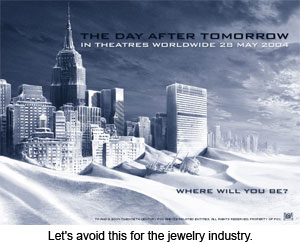 The jewelry industry has it's own Thermohaline Current and right now it's seriously in danger of reversing and flowing the other way. Until recently, the jewelry industry worked like this: Suppliers manufactured jewelry, and sold it to retailers. Retailers then sold it to consumers. Today, increasingly, it's going in the other direction. Consumers are selling gold jewelry to retailers, and retailers are melting it and sending the metal back upstream. Fortunately, I don't think this reversal of Jewelry Current is going to cause weather patterns to change greatly. But it may be causing shopping patterns to change.
I was at a Polygon Conclave in August and the retail jewelers attending were very upbeat and optimistic. Times were good! Money was being made! But the profits weren't from selling diamonds and jewelry, it was from buying jewelry from consumers. The keynote speech was devoted to explaining techniques for doing this effectively.
Now we're coming up on a Holiday Season that follows what's been described as the worst financial meltdown since the Great Depression. If anything, this could increase the flow of the Jewelry Current in the wrong direction. Consumers may be much more likely to want to sell jewelry this Christmas, than buy it.
Is this not shopping-climate change disaster? Our own Day After Tomorrow? Well, no one can predict the future. But, OK, I'll try. The reversal of the Jewelry Current is temporary, and while buying gold off the street may help some jewelers get through a difficult holiday season—and more power to them—it's not a valid long-term model for the majority. So what's a jeweler to do this year? How can you do your part to fight shopping-climate change?
I think jewelers often under-estimate how intimidating it is for many consumers, possibly most consumers, to walk into a jewelry store. Not only are they deeply aware of their ignorance of the product (in most cases), but the average Joe-the-Plumber worries that everything in there is outside his financial reach. Joe-the-Plumber is comfortable in Wal-Mart—maybe this is why Wal-Mart sells so much jewelry—but walking into a fine jewelry store is cause for panic attack.
Maybe your customer isn't Joe-the-Plumber. But there aren't enough well-heeled lawyers and doctors and rich folk to keep all the independent jewelers going strong this season. Just as political candidates need to appeal to independent swing voters, jewelers need to appeal to the middle class.
Jewelry retailers should be attuned to the fact that the "intimidation factor" of a jewelry store may be higher this year, than most. Consumers may feel that a toaster-oven is a more sensible choice. But as the saying goes: "Never give a toaster-oven as a Christmas present to your wife." In tough economic times, love and romance are more important, not less. Finding ways to express those feelings is more important, not less. Giving a deeply personal, luxury gift is easy when times are good. Those who do so this season may find it's even more appreciated.
And those consumers who are brave enough to walk into a jewelry store should know how much they are appreciated as well. This is the year to focus on making that customer comfortable, and making sure they understand that jewelry doesn't have to be un-affordable. Even Tiffany, a few years ago, came out with a heart-charm bracelet in Sterling Silver for under $100. If Tiffany's can offer affordable fine jewelry without damaging its image, your store can probably do so as well. A promotional theme this year might be to emphasize that all price-point customers are welcome.
 "Come see our unique collection of affordable and not-so-affordable jewelry!" "A gift of jewelry this year will be an unexpected surprise." "Some jewelry is expensive. All jewelry is appreciated."
Those are themes that speak subtly to the fact that while many buyers have a lower budget this year, all customers are welcome. Joe-the-Plumber especially.
In fact, with Joe's help we can get Jewelry Circulation flowing in the right direction again, and avoid the perils of shopping-climate change.
Jacques Voorhees
Founder & President
Denver
+1.970.262.7200
usa@polygon.net
Montreal
+1.450.463.8926
canada@polygon.net
London
00.800.7765.9466
uk@polygon.net
Mumbai
+91.22.662.91110
india@polygon.net
Hong Kong
+852.2830.9966
hongkong@polygon.net